
What Is an LED Diode and How Does It Work?
May 15,2025 | JD-SmartLighting
LED technology has become the backbone of modern lighting due to its unmatched energy efficiency, compact design, and long operating life. But beyond its market popularity, understanding how a Light Emitting Diode (LED) works is essential for professionals specifying or sourcing advanced lighting systems.
At JD Smartlighting, we not only supply commercial-grade LED products across Europe—we also help our B2B partners understand the technology behind them, enabling smarter purchasing decisions and better project outcomes.
What Is an LED Diode?
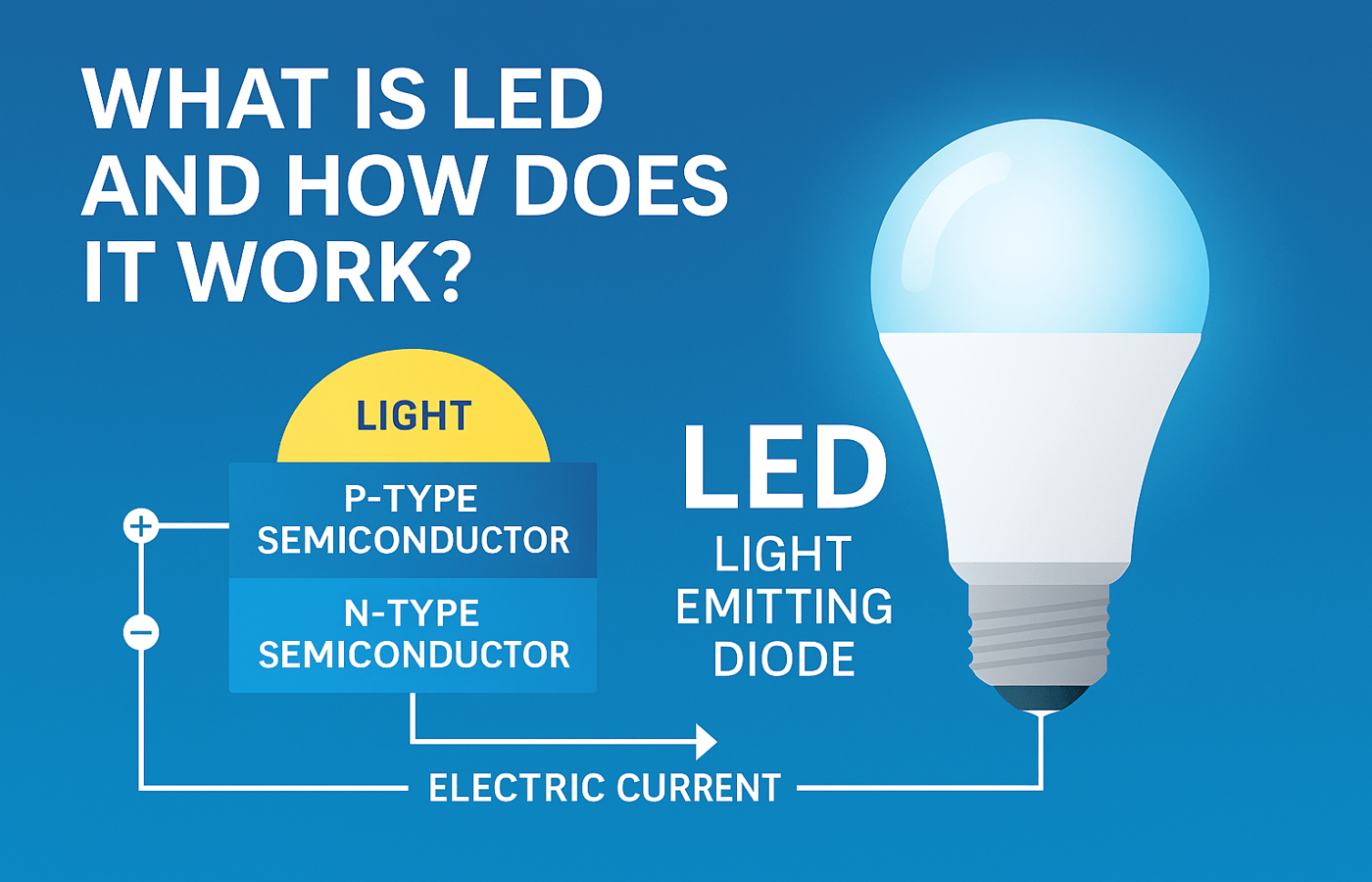
An LED is a semiconductor device that emits light when current flows through it in the forward direction. Unlike traditional bulbs that use thermal radiation, LEDs operate on the principle of electroluminescence: when an electron recombines with a hole in the semiconductor, it releases energy in the form of a photon.
This physical process allows LEDs to convert more electrical energy directly into visible light, minimizing waste in the form of heat.
Semiconductor Materials Matter
The efficiency, color, and brightness of an LED are determined by the bandgap energy of the semiconductor material. Commonly used compounds include:
- Gallium Nitride (GaN) – blue and white LEDs
- Gallium Arsenide (GaAs) – infrared applications
- Aluminum Gallium Indium Phosphide (AlGaInP) – red, orange, and yellow LEDs
For commercial lighting, white light is usually created by using a blue GaN chip coated with a yellow phosphor, resulting in a broad white spectrum.
A Brief History of the LED: From Discovery to Revolution
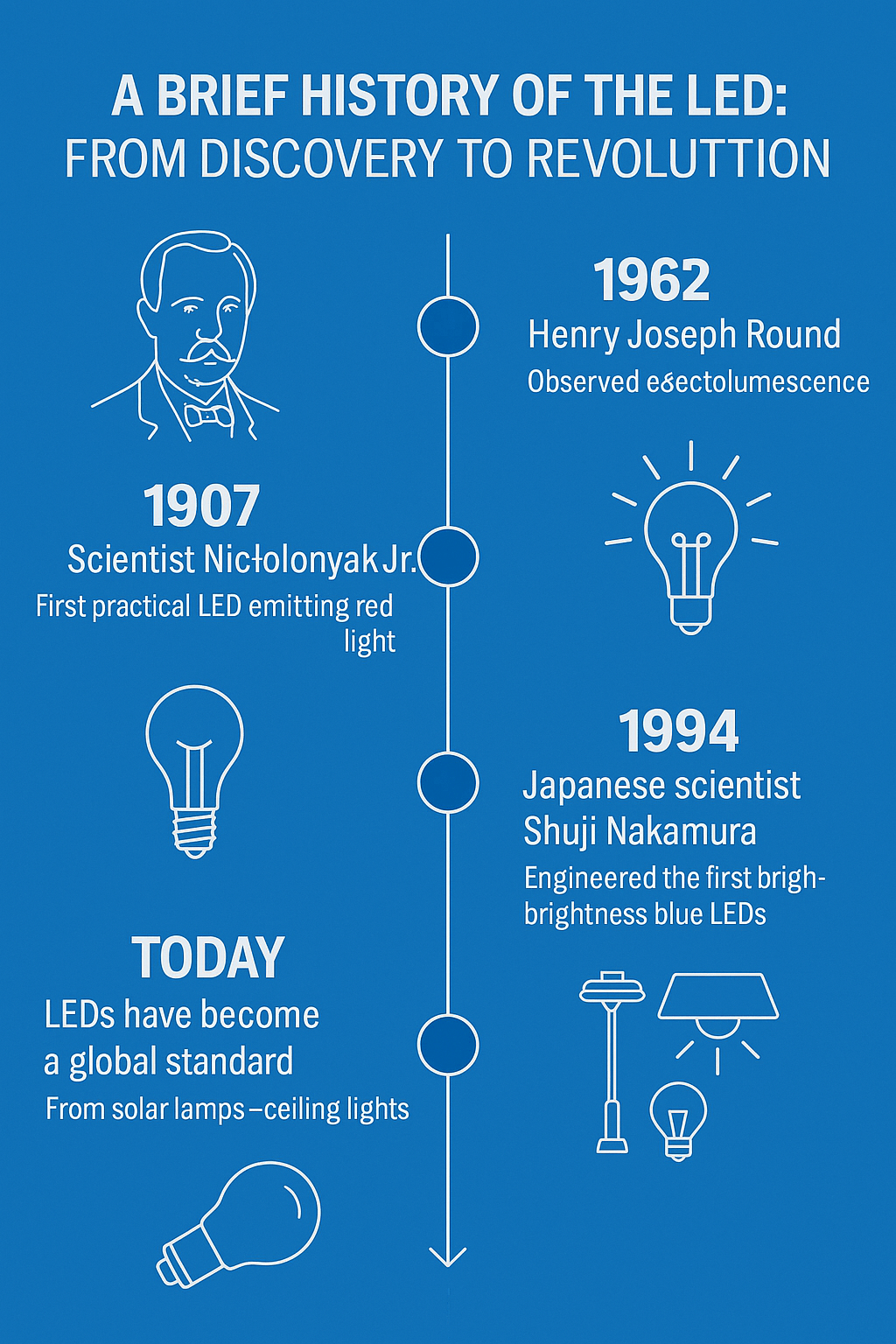
The journey of the LED light is a fascinating story of scientific curiosity, innovation, and transformation. It all began in 1907, when British engineer Henry Joseph Round first observed electroluminescence—the phenomenon of light emitted from a solid-state material when electricity passes through it. But at the time, the idea was far ahead of its practical use.
It wasn’t until 1962 that real progress took shape. At General Electric, scientist Nick Holonyak Jr. developed the first practical LED, which emitted visible red light—a breakthrough that marked the birth of modern LED bulbs.
Over the following decades, researchers expanded the LED color spectrum, introducing orange and green variants. But it was in 1994 that the real turning point arrived: Shuji Nakamura, a Japanese scientist, successfully engineered the first high-brightness blue LED. This paved the way for the development of white LEDs, unlocking the potential for general-purpose, energy-efficient lighting.
Today, that breakthrough has become a global standard. From industrial warehouses to office ceilings, from solar lamps to ceiling fans, LED lights are at the heart of the modern lighting revolution—delivering not just brightness, but efficiency, reliability, and sustainability.
How Does an LED Work in Practical Terms?
In simplified terms, an LED consists of:
- A P-N junction – One side doped with electrons (N-type), the other with holes (P-type).
- Current Flow – When forward-biased, electrons flow from N to P, releasing energy.
- Photon Emission – The energy difference determines the light's color.
LEDs are unidirectional and must be operated with the correct polarity and voltage/current to avoid thermal or electrical failure. That’s why professional-grade LEDs are paired with drivers to regulate input power precisely.
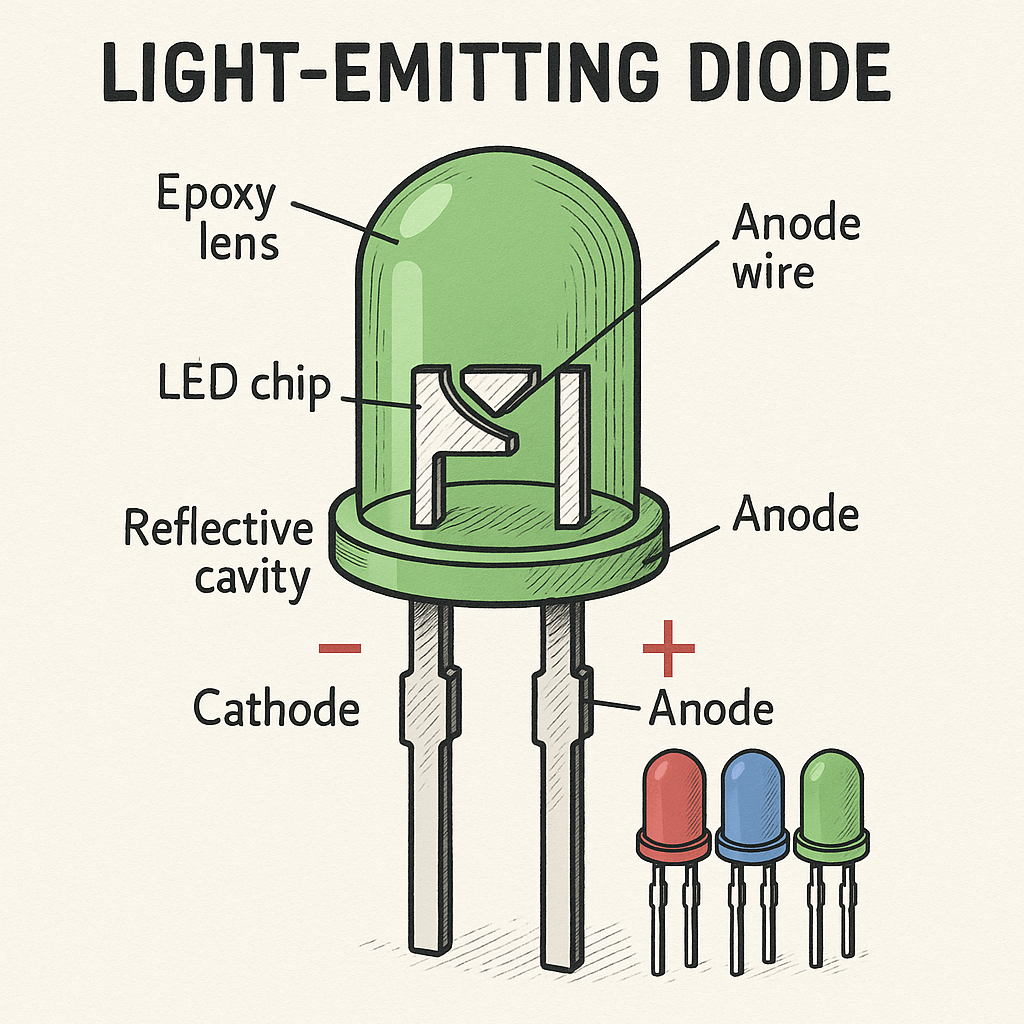
Anatomy of an LED Diode in Lighting Fixtures
| Component | Function |
| Semiconductor Chip | The core element where light is generated. |
| Encapsulation Lens | Focuses or diffuses light; protects the chip. |
| Substrate/Heat Sink | Dissipates heat to extend LED life. |
| Electrodes (Anode/Cathode) | Connect the LED to the circuit. |
| Phosphor Layer | Converts blue light to white in general lighting applications. |
SMD, COB, and High-Power LEDs: What's the Difference?
Different LED packaging technologies serve different lighting needs:
SMD (Surface-Mount Device):
Compact, high-lumen efficiency, widely used in ceiling panels and tube lights.
COB (Chip on Board):
Better heat management and beam uniformity; preferred for downlights and floodlights.
High-Power LEDs:
Designed for street lighting and industrial applications, delivering >1000 lumens per chip with integrated thermal paths.
At JD Smartlighting, we use SMD and COB LEDs across our ceiling lights, solar lights, and floodlights—balancing lumen output, cost, and thermal stability.
Key Advantages of LED Diodes for B2B Projects
Exceptional Luminous Efficacy:
Up to 200 lm/W in professional-grade LEDs, drastically reducing the number of fixtures needed.
Extended Lifespan:
50,000 hours in controlled environments, often exceeding 100,000 hours in premium products.
Low Operating Temperature:
Reduces HVAC load and improves safety.
Compact Size:
Enables slim, modular luminaire designs with integrated control gear.
Instant Response:
No flicker, no delay—ideal for motion-sensor systems or precision lighting.
Low Voltage Operation:
Safer to handle, compatible with solar systems and low-voltage networks.
LED vs. Traditional Lighting
Why LEDs Are the Superior Choice
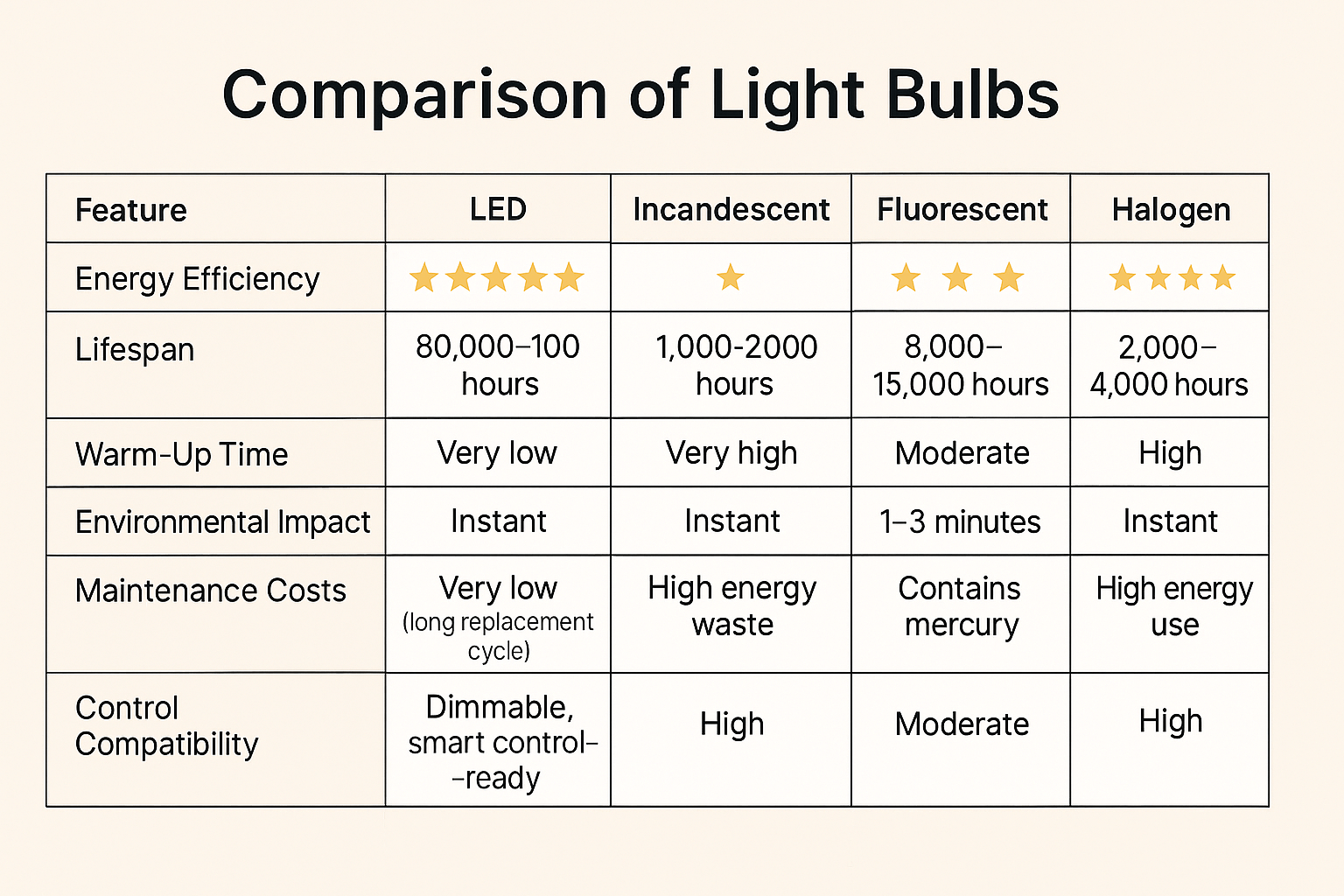
Choosing the right lighting technology can have a major impact on energy consumption, maintenance costs, and overall lighting performance. Here's how LEDs compare with conventional lighting types such as incandescent, halogen, and fluorescent:
Key Advantages of LEDs for Commercial Use
- Lower Total Cost of Ownership (TCO): Despite a slightly higher upfront cost, LEDs pay for themselves within months via reduced electricity bills and fewer replacements.
- Sustainability: LEDs meet EU energy directives, are RoHS-compliant, and support ESG (Environmental, Social, and Governance) goals.
- Design Flexibility: Available in compact, modular, and directional formats—perfect for tailored lighting schemes in retail, hospitality, office, and industrial environments.
- Digital Integration: Compatible with motion sensors, daylight harvesting, and building automation systems.
JD Smartlighting: Your LED Partner in Europe
At JD Smartlighting, all our luminaires—from ceiling lights to solar systems—are powered by next-generation LED modules that meet these advantages head-on. As a trusted LED manufacturer and supplier, JD Smartlighting delivers lighting solutions backed by engineering expertise and rigorous quality control. Our products are designed to meet:
- CE and RoHS certifications
- European safety and photobiological standards (EN62471)
- Customizable requirements for B2B partners
From solar street lights to LED ceiling panels, we help professionals across Europe adopt cutting-edge LED technologies with confidence and technical clarity.
Recommended Reading
LED vs Traditional Lighting: Cost Breakdown for B2B Projects
Understanding CCT and CRI in LED Applications
Why LiFePO₄ Batteries Matter in Solar Lighting
Conclusion
The LED light is much more than a modern convenience—it’s a symbol of how engineering, efficiency, and sustainability can converge in a single, compact form. From its humble beginnings in control panels to illuminating streets, stadiums, and workspaces, the evolution of the LED bulb has completely transformed the way we think about light.
At its core, the LED is powered by electroluminescence—a process that converts electricity into light with unmatched efficiency and precision. This makes LED lights not only more energy-efficient, but also longer-lasting, safer, and more versatile than any lighting technology before it.
For businesses, municipalities, and designers across Europe, LED bulbs are no longer just components—they are the backbone of sustainable, scalable lighting strategies. Whether improving energy savings in a commercial warehouse or enhancing ambience in a retail showroom, LEDs play a quiet but revolutionary role in everyday life.
At JD Smartlighting, we see every LED as part of a larger vision: delivering lighting solutions that are smart, durable, and ready for the challenges of tomorrow. As new innovations emerge—high-power LEDs, connected lighting networks, solar integration—one thing remains clear: the future of light is not only bright, it’s brilliantly engineered.
Comment